
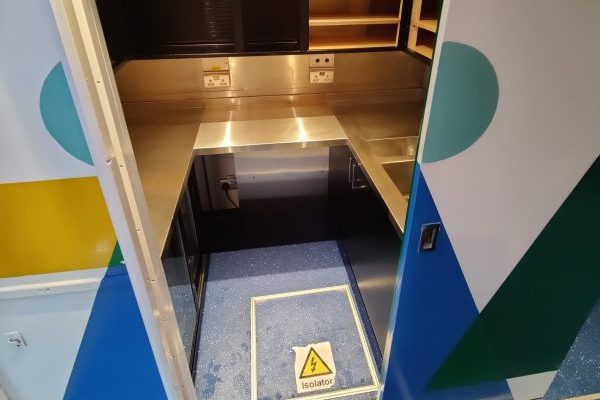
The trials and tribulations of working on a boat, or “I make good life choices, I love working on boats”
Working on boat’s is a pleasure and a privilege, but sometimes it can be a PITA as well.
Top Tips
- Choose a “gospel” and work from there
- Measure off known points
- Take a step back and check, does it look right?
- No spirit level, try a square
- Laser level without self levelling or crossing strings to establish a “plane”
- Check it’ll fit through a door before you buy or build it
The Trials and Tribulations
The most obvious difference must be the size of the space. They’re literally narrow boats (disclaimer, I also work on Dutch Barges, Wide beams and other boats, but you know what I mean). You are tight on space, and this can mean you can’t manoeuvre large materials, don’t have space to work inside and can’t set up tools or put things flat to work on.
I think the second thing most people will think of is just how irregular boats are. Not only are they curved and angled, things are rarely straight, level or square, so how do you deal with this. In my experience it’s best to decide a datum or gospel that you are working to and take measurements from there. You can’t set out a level (spirit levels don’t work) so it needs to be what makes sense visually. This could be the floor, the wall, a counter top. It will vary from project to project and boat to boat.
While you can’t use a level, you can use a square (as large as possible ideally), tape measure and straight edge to lay out most things accurately. I have even been known to make use of a laser level. Cheap ones without self levelling can be handy in establishing a flat plane. If you don’t have one of these you can check the relative plane of four points by tying string between diagonally opposite points and checking if they align where they cross over.
Working on a Boat
Along with the irregular form, you can’t expect boats to follow industry standards for where pipes, cables and other things are laid. Extra care is needed for this, and while it’s unlikely, you really don’t want to drill through the hull below the waterline!
There are some plus sides to boats. Most internal parts are wooden and this makes it easy to fix too. No wall plugs and plaster board or crumbly bricks. You rarely need a ladder and as things are typically smaller they are normally possible to lift by yourself. That said, do check the size of your doors before you buy or build anything you need to get on to the boat.
Finally, even with years of experience, I still like to stop and check what I am doing regularly. If there is one thing that I would stress as the most important, it’s take a step back and look. Does it look right? Even if it measures right, if it looks wrong it probably is. Learn to trust your eyes, after all, it’s how it looks when it’s finished that you will really notice.
Enjoy more reading in these articles.
- The Trials and Tribulations of Working on a Boat – big ways you need to know

- Social Media Posts – Stories – Announcing this is unboxing

- S is for Shelves! See the best ideas
- W is for Wheelhouse, An Awesome and Remarkable Boat Part

- Towpath Talk – Characters of the Cut – January 2026

- New Year’s Sale: Celebrate with 20% Off Everything


Glad we have you to call on to do these jobs, I can’t see myself doing it! Keep up the good work.
This info has been invaluable to me, thank you.
Great stuff, I know who i will call if i need anything.